
The China National Space Administration (CNSA) is the national space agency of China. It is responsible for the national space program[2] and for planning and development of space activities. CNSA and China Aerospace Corporation (CASC) assumed the authority[when?] over space development efforts previously held by the Ministry of Aerospace Industry. It is a subordinate agency of the State Administration for Science, Technology and Industry for National Defence (SASTIND), itself a subordinate agency of the Ministry of Industry and Information Technology (MIIT).
The headquarters are in Haidian District, Beijing.
History
CNSA is a new agency created in 1993 when the Ministry of Aerospace Industry was split into CNSA and the China Aerospace Corporation (CASC). The former was to be responsible for policy, while the latter was to be responsible for execution. This arrangement proved somewhat unsatisfactory, as these two agencies were, in effect, one large agency, sharing both personnel and management.[2]As part of a massive restructuring in 1998, CASC was split into a number of smaller state-owned companies. The intention appeared to have been to create a system similar to that characteristic of Western defense procurement in which entities which are government agencies, setting operational policy, would then contract out their operational requirements to entities which were government-owned, but not government-managed.[2]
Function
CNSA was established as a government institution to develop and fulfill China's due international obligations, with the approval by the Eighth National People's Congress of China (NPC). The Ninth NPC assigned CNSA as an internal structure of the Commission of Science, Technology and Industry for National Defense (COSTIND). CNSA assumes the following main responsibilities: signing governmental agreements in the space area on behalf of organizations, inter-governmental scientific and technical exchanges; and also being in charge of the enforcement of national space policies and managing the national space science, technology and industry.Up to now, China has signed governmental space cooperation agreements with Brazil, Chile, France, Germany, India, Italy, Pakistan, Russia, Ukraine, the United Kingdom, the United States, and some other countries. Significant achievements have been scored in the bilateral and multilateral and technology exchanges and cooperation.[2]
Administrators of CNSA are appointed by the State Council.
Taikonauts
As of 2013, eleven Chinese people have traveled to space (alphabetical order): Fei Junlong (费俊龙)
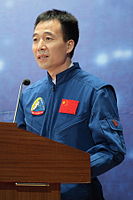 Jing Haipeng(景海鹏)
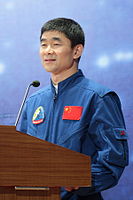 Liu Boming (刘伯明)
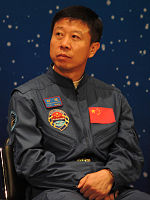 Liu Wang (刘旺)
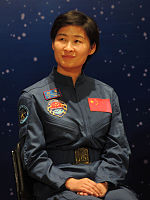 Liu Yang (刘洋)
 Nie Haisheng (聂海胜)
 Yang Liwei (杨利伟)
 Zhai Zhigang (翟志刚)


- Wang Yaping (王亚平)
- Zhang Xiaoguang (张晓光)
- Chen Dong (陈冬)
Administrators
The most recent administrator was Tang Dengjie. Wu Yanhua is vice-administrator and Tian Yulong is secretary general.[3]- April 1993: Liu Jiyuan
- April 1998: Luan Enjie
- 2004: Sun Laiyan
- July 2010: Chen Qiufa[4]
- March 2013: Ma Xingrui[5]
- December 2013: Xu Dazhe[3]
- May 2017: Tang Dengjie
- May 2018: Zhang Kejian
Departments
There are four departments under the CNSA:- Department of General Planning
- Department of System Engineering
- Department of Science, Technology and Quality Control
- Department of Foreign Affairs
No comments:
Post a Comment
Note: only a member of this blog may post a comment.