Space Exploration Technologies Corp.,
doing business as SpaceX, is a
private American
aerospace manufacturer and
space transportation services company headquartered in
Hawthorne, California. It was founded in 2002 by entrepreneur
Elon Musk with the goal of reducing space transportation costs and enabling the
colonization of Mars.
[9][10][11] SpaceX has since developed the
Falcon launch vehicle family and the
Dragon spacecraft family, which both currently deliver payloads into
Earth orbit.
SpaceX's achievements include the first privately funded
liquid-propellant rocket to reach orbit (
Falcon 1 in 2008),
[12] the first private company to successfully launch, orbit, and recover a spacecraft (
Dragon in 2010), the first private company to send a spacecraft to the
International Space Station (Dragon in 2012),
[13] the first
propulsive landing for an orbital rocket (
Falcon 9 in 2015), the first reuse of an orbital rocket (Falcon 9 in 2017), and the first private company to launch an object into
orbit around the sun (
Falcon Heavy's payload of a
Tesla Roadster in 2018). SpaceX has flown 14 resupply missions to the International Space Station (ISS) under a partnership with
NASA.
[14] NASA also awarded SpaceX
a further development contract in 2011 to develop and demonstrate a
human-rated Dragon, which would be used to transport astronauts to the ISS and return them safely to Earth.
SpaceX announced in 2011 that it was beginning a
reusable launch system technology development program. In December 2015, the first
Falcon 9 was flown back to a landing pad near the launch site, where it successfully accomplished a propulsive
vertical landing. This was the first such achievement by a rocket for
orbital spaceflight.
[16] In April 2016, with the launch of
CRS-8, SpaceX successfully vertically landed a first stage on an ocean
drone ship landing platform.
[17] In May 2016, in another first, SpaceX again landed a first stage, but during a significantly more energetic
geostationary transfer orbit mission.
[18] In March 2017, SpaceX became the first to successfully re-launch and land the first stage of an orbital rocket.
SpaceX plans to launch its
Dragon 2 spacecraft in January 2019 and to launch its first crewed spacecraft Dragon 2 in June 2019.
In September 2016, CEO
Elon Musk unveiled the mission architecture of the
Interplanetary Transport System program, an ambitious privately funded initiative to develop spaceflight technology for use in crewed
interplanetary spaceflight. In 2017, Musk unveiled an updated configuration of the system, now named the
BFR, which will be the largest rocket in history and will be fully reusable when it debuts in the early 2020s.
[21] BFR is the acronym for Big Falcon Rocket.
[22] SpaceX revealed on
Twitter that the world’s first private passenger, who was later revealed to be
Yusaku Maezawa, has been signed to fly across the moon in the BFR rocket.
History
SpaceX employees with the Dragon capsule at SpaceX HQ in Hawthorne, California, February 2015
In 2001, Elon Musk conceptualized
Mars Oasis, a project to land a miniature experimental greenhouse and grow
plants on Mars. "This would be the furthest that life’s ever traveled"
[26] in an attempt to regain public interest in space exploration and increase the
budget of NASA.
[27][28][29] Musk tried to buy cheap rockets from Russia but returned empty-handed after failing to find rockets for an affordable price.
[30][31]
On the flight home, Musk realized that he could start a company that could build the affordable rockets he needed.
[31] According to early
Tesla and SpaceX investor
Steve Jurvetson,
[32]
Musk calculated that the raw materials for building a rocket actually
were only three percent of the sales price of a rocket at the time. By
applying
vertical integration,
[30] producing around 85% of launch hardware in-house,
[33][34] and the modular approach from software engineering, SpaceX could cut launch price by a factor of ten and still enjoy a 70%
gross margin.
[35]
Launch of Falcon 9 carrying ORBCOMM OG2-M1
In early 2002, Musk was seeking staff for his new space company, soon to be named SpaceX. Musk approached rocket engineer
Tom Mueller (now SpaceX's CTO of Propulsion) and Mueller agreed to work for Musk, and thus SpaceX was born.
[36] SpaceX was first headquartered in a warehouse in
El Segundo, California. The company has grown rapidly since it was founded in 2002, growing from 160 employees in November 2005 to 1,100 in 2010,
[37][38] 3,800 employees and contractors by October 2013,
[39] and near 5,000 by late 2015.
[40][41]
As of April 2017, the company had nearly 6,000 employees.
[42] In 2016, Musk gave a speech at the
International Astronautical Congress,
where he explained that the US government regulates rocket technology
as an "advanced weapon technology", making it difficult to hire
non-Americans.
[43]
Falcon
9 rocket's first stage on the landing pad after the second successful
vertical landing of an orbital rocket stage, OG2 Mission.
As of March 2018, SpaceX had over 100 launches on its manifest representing about $12 billion in contract revenue.
[44] The contracts included both commercial and
government (NASA/DOD) customers.
[45] In late 2013, space industry media quoted Musk's comments on SpaceX "
forcing…increased competitiveness in the launch industry," its major competitors in the commercial
comsat launch market being
Arianespace,
United Launch Alliance, and
International Launch Services.
[46]
At the same time, Musk also said that the increased competition would
"be a good thing for the future of space." Currently, SpaceX is the
leading global commercial launch provider measured by manifested
launches.
[47]
Falcon 9 first stage on an ASDS barge after the first successful landing at sea, CRS-8 Mission.
Goals
Musk has stated that one of his goals is to decrease the cost and improve the reliability of access to
space, ultimately by a factor of ten.
[48] CEO
Elon Musk said: "I believe $500 per pound ($1,100/kg) or less is very achievable."
[49]
Falcon Heavy Rocket on Launch Pad 39-A in Cape Canaveral, FL
A major goal of SpaceX has been to develop a
rapidly reusable launch system. As of March 2013,
the publicly announced aspects of this technology development effort
include an active test campaign of the low-altitude, low-speed
Grasshopper vertical takeoff, vertical landing (VTVL) technology demonstrator rocket,
[50][51][52] and a high-altitude, high-speed
Falcon 9
post-mission booster return test campaign. In 2015, SpaceX successfully
landed the first orbital rocket on December 21. To date, SpaceX has
successfully landed 25 boosters: 23 Falcon 9 and 2 Falcon Heavy.
[citation needed]
In 2017, SpaceX formed a
subsidiary,
The Boring Company,
[4]
and began work to construct a short underground test tunnel on and
adjacent to the SpaceX headquarters and manufacturing facility,
utilizing a small number of SpaceX employees,
[53] which was completed in May 2018.
[54][55]
At the 2017 International Astronautical Congress in Adelaide,
Australia, Musk announced his plans to build large spaceships to reach
Mars.
[56]
Using the BFR, Musk plans to land at least two uncrewed cargo ships to
Mars in 2022. The first missions will be used to seek out sources of
water and build a propellant plant. In 2024, Musk plans to fly four
additional ships to Mars including the first people. From there,
additional missions would work to establish a Mars colony.
[10][57] Musk's advocacy for the long-term settlement of Mars, goes far beyond what SpaceX projects to build;
[58][59][60]
a successful colonization would ultimately involve many more economic
actors—whether individuals, companies, or governments—to facilitate the
growth of the human presence on Mars over many decades.
[61][62][63]
Achievements
Landmark achievements of SpaceX include:
[64]
- The first privately funded liquid-fueled rocket to reach orbit (Falcon 1 flight 4—September 28, 2008)
- The first privately developed liquid-fueled rocket to put a commercial satellite in orbit (RazakSAT on Falcon 1 flight 5—July 14, 2009)
- The first private company to successfully launch, orbit, and recover a spacecraft (Dragon capsule on COTS demo flight 1—December 9, 2010)
- The first private company to send a spacecraft to the International Space Station (Dragon C2+—May 25, 2012)
- The first private company to send a satellite into geosynchronous orbit (SES-8 on Falcon 9 flight 7—December 3, 2013)
- The first landing of an orbital rocket's first stage on land (Falcon 9 flight 20—December 22, 2015)
- The first landing of an orbital rocket's first stage on an ocean platform (Falcon 9 flight 23—April 8, 2016)
- The first relaunch and landing of a used orbital rocket stage (B1021 on Falcon 9 flight 32—March 30, 2017)[65]
- The first controlled flyback and recovery of a payload fairing (Falcon 9 flight 32—March 30, 2017)[66]
- The first reflight of a commercial cargo spacecraft. (Dragon C106 on CRS-11 mission—June 3, 2017)[67]
Setbacks
In March 2013, a
Dragon spacecraft in
orbit
developed issues with its thrusters that limited its control
capabilities. SpaceX engineers were able to remotely clear the blockages
within a short period, and the spacecraft was able to successfully
complete its mission to and from the
International Space Station.
In June 2015,
CRS-7 launched a
Dragon capsule atop a
Falcon 9 to resupply the
International Space Station. All
telemetry
readings were nominal until 2 minutes and 19 seconds into the flight,
when a loss of helium pressure was detected and a cloud of vapor
appeared outside the second stage. A few seconds after this, the second
stage exploded. The first stage continued to fly for a few seconds
before disintegrating due to
aerodynamic forces. The capsule was thrown off and survived the explosion, transmitting data until it was destroyed on impact.
[68] Later it was revealed that the capsule could have landed intact if it had
software to deploy its parachutes in case of a launch mishap.
[69] The problem was discovered to be a failed 2-foot-long steel strut purchased from a supplier to hold a
helium pressure vessel that broke free due to the force of
acceleration.
[70]
This caused a breach and allowed high-pressure helium to escape into
the low-pressure propellant tank, causing the failure. The
Dragon
software issue was also fixed in addition to an analysis of the entire
program in order to ensure proper abort mechanisms are in place for
future rockets and their payload.
[71]
In September 2016, a Falcon 9 exploded during a propellant fill operation for a standard pre-launch
static fire test.
[72][73] The payload, the
Spacecom Amos-6 communications satellite valued at $200 million, was destroyed.
[74]
Musk described the event as the "most difficult and complex failure"
ever in SpaceX's history; SpaceX reviewed nearly 3,000 channels of
telemetry and video data covering a period of 35–55 milliseconds for the
postmortem.
[75]
Musk reported the explosion was caused by the liquid oxygen that is
used as propellant turning so cold that it solidified and it ignited
with
carbon composite helium vessels.
[76]
Though not considered an unsuccessful flight, the rocket explosion sent
the company into a four-month launch hiatus while it worked out what
went wrong, and SpaceX returned to flight in January 2017.
[77]
In February 2018, the
Falcon Heavy center core crashed about 100 meters from its target, the
autonomous spaceport drone ship,
"Of Course I Still Love You", when two of the three engines did not
fire during the final landing burn. Elon Musk said on the disaster, "Not
enough ignition fluid to light the outer two engines after several
three engine relights," Musk wrote. "Fix is pretty obvious." The other
two boosters were able to successfully simultaneously land on a pair of
landing pads at
Cape Canaveral Air Force Station.
[78]
Ownership, funding and valuation
In August 2008, SpaceX accepted a $20 million investment from
Founders Fund.
[79] In early 2012, approximately two-thirds of the company were owned by its founder
[80] and his 70 million shares were then estimated to be worth $875 million on
private markets,
[81] which roughly valued SpaceX at $1.3 billion as of February 2012.
[82] After the
COTS 2+ flight in May 2012, the company private equity valuation nearly doubled to $2.4 billion.
[83][84] In January 2015, SpaceX raised $1 billion in funding from
Google and
Fidelity,
in exchange for 8.333% of the company, establishing the company
valuation at approximately $12 billion. Google and Fidelity joined prior
investors Draper Fisher Jurvetson, Founders Fund, Valor Equity Partners
and Capricorn.
[85][86] In July 2017, the Company raised US$350m at a valuation of US$21 billion.
[87]
As of May 2012, SpaceX had operated on total funding of
approximately $1 billion in its first ten years of operation. Of this,
private equity provided about $200M, with Musk investing approximately
$100M and other investors having put in about $100M (
Founders Fund,
Draper Fisher Jurvetson, ...).
[88]
The remainder has come from progress payments on long-term launch
contracts and development contracts. By March 2018, SpaceX had contracts
for 100 launch missions, and each of those contracts provide down
payments at contract signing, plus many are paying progress payments as
launch vehicle components are built in advance of mission launch, driven
in part by US accounting rules for
recognizing long-term revenue.
[45]
Successful SpaceX launches by year
[89]
Congressional testimony by SpaceX in 2017 suggested that the NASA
Space Act Agreement process of "setting only a
high-level requirement
for cargo transport to the space station [while] leaving the details to
industry" had allowed SpaceX to design and develop the Falcon 9 rocket
on its own at substantially lower cost. "According to
NASA's
own independently verified numbers, SpaceX’s development costs of both
the Falcon 1 and Falcon 9 rockets were estimated at approximately
US$390 million in total. "In 2011, NASA estimated that it would have cost the agency about
US$4 billion
to develop a rocket like the Falcon 9 booster based upon NASA's
traditional contracting processes". The Falcon 9 launch system, with an
estimated improvement at least four to ten times over traditional
cost-plus contracting estimates, about $400 million vs. $4 billion in
savings through the usage of Space Act Agreements.
[90]
Spacecraft and flight hardware
SpaceX currently manufactures three broad classes of rocket engine in-house: the kerosene fueled
Merlin engines, the methane fueled
Raptor engines, and the
hypergolic fueled Draco/SuperDraco
vernier thrusters. The Merlin powers their two main space launch vehicles: the
Falcon 9,
[91] which flew successfully into orbit on its maiden launch in June 2010
[92] and the
super-heavy class
Falcon Heavy, which was launched for the first time on February 6, 2018. SpaceX also manufactures the
Dragon,
a pressurized orbital spacecraft that is launched on top of a Falcon 9
booster to carry cargo to low Earth orbit, and the follow-on
Dragon 2 spacecraft, or
Crew Dragon, currently in the process of being human-rated through a variety of design reviews and
flight tests that began in 2014.
[93][94]
SpaceX's Falcon 9 rocket carrying the Dragon spacecraft, lifts off during the
COTS Demo Flight 1 in December 2010.
Rocket engines
Since the founding of SpaceX in 2002, the company has developed three families of
rocket engines —
Merlin and the retired
Kestrel for
launch vehicle propulsion, and the
Draco control thrusters. SpaceX is currently
developing two further rocket engines:
SuperDraco and
Raptor. SpaceX is currently the world’s most prolific producer of liquid fuel rocket engines.
[95]
Merlin is a family of rocket engines developed by SpaceX for use on its
Falcon rocket family. Merlin engines use
LOX and
RP-1
as propellants in a gas-generator power cycle. The Merlin engine was
originally designed for sea recovery and reuse. The injector at the
heart of Merlin is of the
pintle type that was first used in the
Apollo Program for the lunar module landing engine. Propellants are fed via a single shaft, dual impeller
turbo-pump.
Kestrel is a LOX/RP-1
pressure-fed
rocket engine, and was used as the Falcon 1 rocket's second stage main
engine. It is built around the same pintle architecture as SpaceX's
Merlin engine but does not have a
turbo-pump, and is fed only by
tank pressure. Its nozzle is
ablatively cooled in the chamber and throat, is also
radiatively cooled, and is fabricated from a high strength
niobium alloy.
Both names for the
Merlin and
Kestrel engines are derived from species of North American falcons: the
kestrel and the
merlin.
[96]
Draco are
hypergolic liquid-propellant rocket engines that utilize
monomethyl hydrazine fuel and
nitrogen tetroxide oxidizer. Each Draco thruster generates 400 newtons (90 lbf) of thrust.
[97] They are used as
reaction control system (RCS) thrusters on the
Dragon spacecraft.
[98] SuperDraco engines are a much more powerful version of the Draco thrusters, which will be initially used as landing and
launch escape system engines on the version 2 Dragon spacecraft,
Dragon 2.
Raptor is a new family of
methane-fueled full flow staged combustion cycle engines to be used in its future Interplanetary Transport System. Development versions have been test fired.
[99]
Falcon launch vehicles
The Falcon 1 prototype at SpaceX's assembly facilities.
Since 2010, SpaceX has flown all its missions on the
Falcon 9, with one test flight of
Falcon Heavy. They previously developed and flew the
Falcon 1 pathfinder vehicle.
Falcon 1 was a small rocket capable of placing several hundred kilograms into low earth orbit.
[92] It functioned as an early test-bed for developing concepts and components for the larger Falcon 9.
[92]
Falcon 1 attempted five flights between 2006 and 2009. With Falcon I,
when Musk announced his plans for it before a subcommittee in the Senate
in 2004, he discussed that Falcon I would be the 'worlds only
semi-reusable orbital rocket' apart from the space shuttle.
[100]
On September 28, 2008, on its fourth attempt, the Falcon 1 successfully
reached orbit, becoming the first privately funded, liquid-fueled
rocket to do so.
[101]
Falcon 9 is an
EELV-class
medium-lift vehicle capable of delivering up to 22,800 kilograms (50,265 lb) to orbit, and is intended to compete with the
Delta IV and the
Atlas V rockets, as well as other launch providers around the world. It has nine
Merlin engines in its first stage.
[102] The
Falcon 9 v1.0 rocket successfully reached orbit on its first attempt on June 4, 2010. Its third flight,
COTS Demo Flight 2, launched on May 22, 2012, and was the first
commercial spacecraft to reach and dock with the International Space Station.
[103] The vehicle was upgraded to
Falcon 9 v1.1 in 2013 and again in 2015 to the current
Falcon 9 Full Thrust version. As of February 2018, Falcon 9 vehicles have flown
49 successful missions
with one failure, the CRS-7 mission. An additional vehicle was
destroyed during a routine test several days prior to a scheduled launch
in 2016.
In 2011, SpaceX began development of the
Falcon Heavy, a
heavy-lift rocket configured using a cluster of three Falcon 9 first stage
cores with a total 27
Merlin 1D engines and
propellant crossfeed.
[104][105] The Falcon Heavy successfully flew on its inaugural mission on February 6, 2018 with a payload consisting of Musk's personal
Tesla Roadster into
heliocentric orbit[106] The Falcon Heavy is the world's most powerful rocket in operation.
[107] The first stage would be capable of lifting 63,800 kilograms (140,660 lb) to
LEO with the 27 Merlin 1D engines producing 22,819
kN of thrust at sea level, and 24,681 kN in space.
Dragon capsules
The Dragon spacecraft approaching the ISS
In 2005, SpaceX announced plans to pursue a human-rated commercial space program through the end of the decade.
[108]
The Dragon is a conventional blunt-cone ballistic capsule which is
capable of carrying cargo or up to seven astronauts into orbit and
beyond.
[109][109]
In 2006, NASA announced that the company was one of two selected
to provide crew and cargo resupply demonstration contracts to the ISS
under the COTS program.
[110] SpaceX demonstrated cargo resupply and eventually crew transportation services using the Dragon.
[103]
The first flight of a Dragon structural test article took place in June
2010, from Launch Complex 40 at Cape Canaveral Air Force Station during
the maiden flight of the
Falcon 9 launch vehicle; the
mock-up
Dragon lacked avionics, heat shield, and other key elements normally
required of a fully operational spacecraft but contained all the
necessary characteristics to validate the flight performance of the
launch vehicle.
[111] An operational Dragon spacecraft was launched in December 2010 aboard
COTS Demo Flight 1, the Falcon 9's second flight, and safely returned to Earth after two orbits, completing all its mission objectives.
[93] In 2012, Dragon became the first commercial spacecraft to deliver cargo to the International Space Station,
[103] and has since been conducting regular resupply services to the ISS.
[112]
The interior of the COTS 2 Dragon
In April 2011, NASA issued a $75 million contract, as part of its second-round
commercial crew development
(CCDev) program, for SpaceX to develop an integrated launch escape
system for Dragon in preparation for human-rating it as a crew transport
vehicle to the ISS.
[113] In August 2012, NASA awarded SpaceX a firm, fixed-price
SAA
with the objective of producing a detailed design of the entire crew
transportation system. This contract includes numerous key technical and
certification milestones, an uncrewed flight test, a crewed flight
test, and six operational missions following system certification.
[114]
The fully autonomous Crew Dragon spacecraft is expected to be one of
the safest crewed spacecraft systems. Reusable in nature, the Crew
Dragon will offer savings to NASA.
[114]
SpaceX plans to launch its Dragon 2 spacecraft on an uncrewed
test flight to the ISS in November 2018, and in April 2019, a crewed
Dragon will send US astronauts to the ISS for the first time since the
retirement of the
Space Shuttle.
[115][116] In February 2017 SpaceX announced that two would-be
space tourists
had put down "significant deposits" for a mission which would see the
two private astronauts fly on board a Dragon capsule around the moon and
back again.
In addition to SpaceX's privately funded plans for an eventual
Mars mission, NASA
Ames Research Center had developed a concept called
Red Dragon: a low-cost Mars mission that would use
Falcon Heavy as the launch vehicle and trans-Martian injection vehicle, and the
Dragon capsule to
enter the
Martian atmosphere. The concept was originally envisioned for launch in 2018 as a
NASA Discovery mission, then alternatively for 2022
[117]
The objectives of the mission would be return the samples from Mars to
Earth at a fraction of the cost of the NASA own return-sample mission
now projected at 6 billion dollars.
[117] [118]
In September 2017,
Elon Musk
released first prototype images of their space suits to be used in
future missions. The suit is in testing phase and it is designed to cope
with 2 ATM pressure in vacuum.
[119][120]
Research and development
First test firing of a scale Raptor development engine in September 2016 in McGregor, Texas.
SpaceX is actively pursuing several different
research and development
programs. Most notable are those intended to develop reusable launch
vehicles, an interplanetary transport system and a global
telecommunications network.
SpaceX has on occasion developed new engineering development
technologies to enable it to pursue its various goals. For example, at
the 2015
GPU Technology Conference, SpaceX revealed their own
computational fluid dynamics (CFD) software to improve the
simulation capability of evaluating rocket engine combustion design.
[121][122]
Reusable launch system
SpaceX's reusable launcher program was publicly announced in 2011 and
the design phase was completed in February 2012. The system returns the
first stage of a
Falcon 9 rocket to a predetermined landing site using only its own propulsion systems.
[123]
SpaceX's active test program began in late 2012 with testing low-altitude, low-speed aspects of the
landing technology.
Grasshopper and the Falcon 9 Reusable Development Vehicles (F9R Dev) were experimental
technology-demonstrator reusable rockets that performed vertical takeoffs and landings.
High-velocity, high-altitude aspects of the
booster atmospheric return technology began testing in late 2013 and have continued through 2018, with a 98% success rate to
date.
As a result of Elon Musk's goal of crafting more cost-effective launch
vehicles, SpaceX conceived a method to reuse the first stage of their
primary rocket, the
Falcon 9,
[124]
by attempting propulsive vertical landings on solid surfaces. Once the
company determined that soft landings were feasible by touching down
over the Atlantic and Pacific Ocean, they began landing attempts on a
solid platform. SpaceX leased and modified several barges to sit out at
sea as a target for the returning first stage, converting them to
autonomous spaceport drone ships (ASDS). SpaceX first achieved a
successful landing and recovery of a first stage in December 2015,
[125] and in April 2016, the first stage booster first successfully landed on the ASDS
Of Course I Still Love You.
[126][127]
SpaceX continues to carry out first stage landings on every
orbital launch that fuel margins allow. By October 2016, following the
successful landings, SpaceX indicated they were offering their customers
a ten percent price discount if they choose to fly their payload on a
reused Falcon 9 first stage.
[128] On March 30, 2017, SpaceX launched a "flight-proven" Falcon 9 for the
SES-10 mission. This was the first time a re-launch of a payload-carrying orbital rocket went back to space.
[129][65] The first stage was recovered and landed on the ASDS
Of Course I Still Love You
in the Atlantic Ocean, also making it the first landing of a reused
orbital class rocket. Elon Musk called the achievement an "incredible
milestone in the history of space."
[130][131]
Interplanetary Transport System / BFR
SpaceX is developing a super-heavy lift launch system, the
BFR.
The BFR is a fully reusable first stage launch vehicle and spacecraft
intended to replace all of the company's existing hardware by the early
2020s, ground infrastructure for rapid launch and relaunch, and
zero-gravity propellant transfer technology in
low Earth orbit (LEO).
SpaceX initially envisioned the ITS vehicle design which was
solely aimed at Mars transit and other interplanetary uses, SpaceX in
2017 began to focus on a vehicle support all SpaceX launch service
provider capabilities: Earth-orbit, lunar-orbit, interplanetary
missions, and even intercontinental passenger transport on Earth.
[132] The BFR will be the world’s most powerful rocket.
[45]
Musk's long term vision for the company is the development of
technology and resources suitable for human colonization on Mars. He has
expressed his interest in someday traveling to the planet, stating "I'd
like to die on Mars, just not on impact."
[133] A rocket every two years or so could provide a base for the people arriving in 2025 after a launch in 2024.
[134][135]
According to Steve Jurvetson, Musk believes that by 2035 at the latest,
there will be thousands of rockets flying a million people to Mars, in
order to enable a self-sustaining human colony.
[136]
Other projects
In January 2015, SpaceX CEO
Elon Musk announced the development of
a new satellite constellation
to provide global broadband internet service. In June 2015 the company
asked the federal government for permission to begin testing for a
project that aims to build a constellation of 4,425 satellites capable
of beaming the Internet to the entire globe, including remote regions
which currently do not have Internet access.
[137][138] The Internet service would use a constellation of 4,425 cross-linked
communications satellites
in 1,100 km orbits. Owned and operated by SpaceX, the goal of the
business is to increase profitability and cashflow, to allow SpaceX to
build its Mars colony.
[139] Development began in 2015, initial prototype
test-flight
satellites were launched on the SpaceX PAZ mission in 2017. Initial
operation of the constellation could begin as early as 2020. As of
March 2017, SpaceX filed with the
US regulatory authorities plans to field a constellation of an additional 7,518 "
V-band satellites in non-
geosynchronous orbits
to provide communications services" in an electromagnetic spectrum that
had not previously been "heavily employed for commercial communications
services". Called the "V-band low-Earth-orbit (VLEO) constellation", it
would consist of "7,518 satellites to follow the [earlier] proposed
4,425 satellites that would function in
Ka- and
Ku-band".
[140]
In June 2015, SpaceX announced that they would sponsor a
Hyperloop competition, and would build a 1-mile-long (1.6 km)
subscale test track near SpaceX's headquarters for the competitive events.
[141][142] The first competitive event was held at the track in January 2017 and the second in August 2017.
[143][144] A third event is planned for late 2018.
[145]
Infrastructure
SpaceX is
headquartered
in California, which also serves as its primary manufacturing plant.
The company owns a test site in Texas and operates three launch sites,
with another under development. SpaceX also operates regional offices in
Redmond, Texas, Virginia, and Washington, D.C.
[45]
Headquarters, manufacturing and refurbishment facilities
Falcon 9 v1.1 rocket cores under construction at the SpaceX Hawthorne facility, November 2014.
SpaceX Headquarters is located in the
Los Angeles suburb of
Hawthorne, California. The large three-story facility, originally built by
Northrop Corporation to build
Boeing 747 fuselages,
[146]
houses SpaceX's office space, mission control, and, as of 2018, all
vehicle manufacturing. In March 2018, SpaceX indicated that it would
manufacture its next-generation, 9 m (30 ft)-diameter launch vehicle,
the
BFR at a new facility it is building on the
Los Angeles waterfront in the
San Pedro
area. The company has leased an 18-acre site near Berth 240 in the Los
Angeles port for 10 years, with multiple renewals possible, and will use
the site for manufacturing, recovery from shipborne landings, and
refurbishment of both the BFR booster and the BFR spaceship.
[147][148]
The area has one of the largest concentrations of aerospace
headquarters, facilities, and/or subsidiaries in the U.S., including
Boeing/McDonnell Douglas main satellite building campuses,
Aerospace Corp.,
Raytheon, NASA's
Jet Propulsion Laboratory,
Air Force Space Command's
Space and Missile Systems Center at
Los Angeles Air Force Base,
Lockheed Martin,
BAE Systems,
Northrop Grumman, and
AECOM, etc., with a large pool of aerospace engineers and recent college engineering graduates.
[146]
SpaceX utilizes a high degree of
vertical integration in the production of its rockets and rocket engines.
[30] SpaceX builds its
rocket engines,
rocket stages,
spacecraft, principal
avionics and all
software
in-house in their Hawthorne facility, which is unusual for the
aerospace industry. Nevertheless, SpaceX still has over 3,000 suppliers
with some 1,100 of those delivering to SpaceX nearly weekly.
[149]
In June 2017, SpaceX announced they would construct a facility on 0.88 hectares (2.17 acres) in
Port Canaveral Florida for refurbishment and storage of previously-flown Falcon 9 and Falcon Heavy booster cores.
[150][needs update]
Development and test facility
SpaceX McGregor engine test bunker, September 2012
SpaceX operates their Rocket Development and Test Facility in
McGregor, Texas. All SpaceX rocket engines are tested on
rocket test stands, and low-altitude VTVL flight testing of the Falcon 9
Grasshopper v1.0 and
F9R Dev1 test vehicles were carried out at McGregor.
The company purchased the McGregor facilities from
Beal Aerospace, where it refitted the largest test stand for
Falcon 9
engine testing. SpaceX has made a number of improvements to the
facility since purchase, and has also extended the acreage by purchasing
several pieces of adjacent farmland. In 2011, the company announced
plans to upgrade the facility for launch testing a VTVL rocket,
[50] and then constructed a half-acre concrete launch facility in 2012 to support the Grasshopper test flight program.
[51] As of October 2012, the McGregor facility had seven test stands that are operated "18 hours a day, six days a week"
[151] and is building more test stands because production is ramping up and the company has a large
manifest in the next several years.
[needs update]
In addition to routine testing, Dragon capsules (following
recovery after an orbital mission), are shipped to McGregor for
de-fueling, cleanup, and refurbishment for reuse in future missions.
Launch facilities
SpaceX currently operates three
orbital launch sites, at
Cape Canaveral,
Vandenberg Air Force Base, and
Kennedy Space Center,
and have announced plans for a fourth in Brownsville, Texas. SpaceX has
indicated that they see a niche for each of the four orbital facilities
and that they have sufficient launch business to fill each pad.
[152]
The Vandenberg launch site enables highly inclined orbits (66–145°),
while Cape Canaveral enables orbits of medium inclination, up to 51.6°.
[153] Before it was retired, all
Falcon 1 launches took place at the
Ronald Reagan Ballistic Missile Defense Test Site on
Omelek Island.
Cape Canaveral
Cape Canaveral Air Force Station Space Launch Complex 40
(SLC-40) is used for Falcon 9 launches to low Earth and geostationary
orbits. SLC-40 is not capable of supporting Falcon Heavy launches. As
part of SpaceX's booster reusability program, the former Launch Complex
13 at Cape Canaveral, now renamed
Landing Zone 1, has been designated for use for Falcon 9
first-stage booster landings.
Vandenberg
Vandenberg Air Force Base Space Launch Complex 4 East (SLC-4E) is used for payloads to polar orbits. The Vandenberg site can launch both Falcon 9 and Falcon Heavy,
[154] but cannot launch to low inclination orbits. Post-launch landings will take place at the neighboring SLC-4W.
Kennedy Space Center
On April 14, 2014, SpaceX signed a 20-year lease for
Launch Pad 39A.
[155] The pad was subsequently modified to support
Falcon 9 and
Falcon Heavy launches. SpaceX has launched 13 Falcon 9 missions from
Launch Pad 39A and more recently the
Falcon Heavy, on February 6, 2018. SpaceX intends to launch the first crewed missions to the ISS from
Launch Pad 39A in December 2018.
[156]
Brownsville
In August 2014, SpaceX announced they would be building a
commercial-only launch facility at
Brownsville, Texas.
[157][158] The
Federal Aviation Administration released a draft
Environmental Impact Statement
for the proposed Texas facility in April 2013, and "found that 'no
impacts would occur' that would force the Federal Aviation
Administration to deny SpaceX a permit for rocket operations,"
[159][159] and issued the permit in July 2014.
[160] SpaceX started construction on the new launch facility in 2014 with production ramping up in the latter half of 2015,
[161] with the first launches from the facility no earlier than late 2018.
[162] Real estate packages at the location have been named by SpaceX with names based on the theme "
Mars Crossing".
[163][164]
Satellite prototyping facility
In January 2015, SpaceX announced it would be entering the satellite
production business and global satellite internet business. The first
satellite facility is a 30,000 square foot (2800m
2) office
building located in Redmond, Washington. As of January 2017, a second
facility in Redmond was acquired with 40,625 square feet (3800m
2) and has become a research and development lab for the satellites.
[165] In July 2016, SpaceX acquired an additional 740 square meters (8,000 sq ft) creative space in
Irvine, California (Orange County) to focus on satellite communications.
[166]
Launch contracts
SpaceX won demonstration and actual supply contracts from
NASA for the
International Space Station (ISS) with technology the company developed. SpaceX is also certified for
US military launches of
Evolved Expendable Launch Vehicle-class (EELV) payloads. With approximately 30 missions on manifest for 2018 alone, SpaceX represents over $12B under contract.
[45]
NASA contracts
COTS
The COTS 2 Dragon is berthed to the ISS by
Canadarm2.
In 2006, NASA announced that SpaceX had won a NASA Commercial Orbital
Transportation Services (COTS) Phase 1 contract to demonstrate cargo
delivery to the ISS, with a possible contract option for crew transport.
[167][168]
This contract, designed by NASA to provide "seed money" through Space
Act Agreements for developing new capabilities, NASA paid SpaceX $396
million to develop the cargo configuration of the Dragon spacecraft,
while SpaceX self-invested more than $500 million to develop the Falcon 9
launch vehicle.
[169] These
Space Act Agreements
have been shown to have saved NASA millions of dollars in development
costs, making rocket development ~4-10 times cheaper than if produced by
NASA alone.
[90]
In December 2010, the launch of the
COTS Demo Flight 1 mission, SpaceX became the first private company to successfully launch, orbit and recover a spacecraft.
[170]
Dragon was successfully deployed into orbit, circled the Earth twice,
and then made a controlled re-entry burn for a splashdown in the Pacific
Ocean. With Dragon's safe recovery, SpaceX became the first private
company to launch, orbit, and recover a spacecraft; prior to this
mission, only government agencies had been able to recover orbital
spacecraft.
COTS Demo Flight 2
launched in May 2012, in which Dragon successfully berthed with the
ISS, marking the first time that a private spacecraft had accomplished
this feat.
[171][172]
Commercial cargo
Commercial Resupply Services (CRS) are a series of contracts awarded
by NASA from 2008–2016 for delivery of cargo and supplies to the ISS on
commercially operated spacecraft. The first CRS contracts were signed in
2008 and awarded $1.6 billion to SpaceX for 12 cargo transport
missions, covering deliveries to 2016.
[173] SpaceX CRS-1,
the first of the 12 planned resupply missions, launched in October
2012, achieved orbit, berthed and remained on station for 20 days,
before
re-entering the atmosphere and splashing down in the Pacific Ocean.
[174]
CRS missions have flown approximately twice a year to the ISS since
then. In 2015, NASA extended the Phase 1 contracts by ordering an
additional three resupply flights from SpaceX.
[175][176] After further extensions late in 2015, SpaceX is currently scheduled to fly a total of 20 missions.
[177]
A second phase of contracts (known as CRS2) were solicited and proposed
in 2014. They were awarded in January 2016, for cargo transport flights
beginning in 2019 and expected to last through 2024.
Commercial crew
Crew Dragon undergoing testing prior to flight
The Commercial Crew Development (CCDev) program intends to develop
commercially operated spacecraft that are capable of delivering
astronauts to the ISS. SpaceX did not win a
Space Act Agreement
in the first round (CCDev 1), but during the second round (CCDev 2),
NASA awarded SpaceX with a contract worth $75 million to further develop
their
launch escape system, test a crew accommodations mock-up, and to further progress their Falcon/Dragon crew transportation design.
[178][179][180] The CCDev program later became Commercial Crew Integrated Capability (
CCiCap), and in August 2012, NASA announced that SpaceX had been awarded $440 million to continue development and testing of its
Dragon 2 spacecraft.
[181][182]
In September 2014, NASA chose SpaceX and Boeing as the two
companies that will be funded to develop systems to transport U.S. crews
to and from the ISS. SpaceX won $2.6 billion to complete and certify
Dragon 2 by 2017. The contracts include at least one crewed flight test
with at least one NASA astronaut aboard. Once Crew Dragon achieves NASA
certification, the contract requires SpaceX to conduct at least two, and
as many as six, crewed missions to the space station.
[183] In early 2017, SpaceX was awarded four additional crewed missions to the ISS from NASA to shuttle astronauts back and forth.
[184]
US Defense contracts
In 2005, SpaceX announced that it had been awarded an
Indefinite Delivery/Indefinite Quantity (IDIQ) contract for Responsive Small Spacelift (RSS) launch services by the
United States Air Force, which could allow the Air Force to purchase up to $100 million worth of launches from the company.
[185] In April 2008,
NASA
announced that it had awarded an IDIQ Launch Services contract to
SpaceX for up to $1 billion, depending on the number of missions
awarded. The contract covers launch services ordered by June 2010, for
launches through December 2012.
[186] Musk stated in the same 2008 announcement that SpaceX has sold 14 contracts for flights on the various
Falcon vehicles.
[186] In December 2012, SpaceX announced its first two launch contracts with the
United States Department of Defense. The
United States Air Force Space and Missile Systems Center awarded SpaceX two EELV-class missions:
Deep Space Climate Observatory (DSCOVR) and
Space Test Program 2 (STP-2). DSCOVR was launched on a
Falcon 9 launch vehicle in 2015, while STP-2 will be launched on a
Falcon Heavy in 2018.
[187]
In May 2015, the United States Air Force announced that the
Falcon 9 v1.1
was certified for launching "national security space missions," which
allows SpaceX to contract launch services to the Air Force for any
payloads classified under national security.
[188] This broke the monopoly held since 2006 by ULA over the US Air Force launches of classified payloads.
[189]
In April 2016, the U.S. Air Force awarded the first such national
security launch, an $82.7 million contract to SpaceX to launch the 2nd
GPS III satellite in May 2018; this estimated cost was approximately 40% less than the estimated cost for similar previous missions.
[190][191][192] Prior to this,
United Launch Alliance was the only provider certified to launch national security payloads.
[193][193][194] ULA did not submit a bid for the May 2018 launch.
[195][196]
In 2016 the US
National Reconnaissance Office said it had purchased launches from SpaceX - the first (for
NROL-76) took place on 1st May 2017.
[197]
In March 2017 SpaceX won (vs ULA) with a bid of $96.5 million for the 3rd GPS III launch (due Feb 2019).
[198]
In March 2018, SpaceX secured an additional $290 million contract
from the U.S. Air Force to launch three next generation GPS satellites,
known as GPS III. The first of these launches is expected to take place
in March 2020.
[199]
Launch market competition and pricing pressure
SpaceX's low launch prices, especially for
communication satellites flying to
geostationary (GTO) orbit, have resulted in
market pressure on its competitors to lower their own prices.
[30] Prior to 2013, the
openly competed comsat launch market had been dominated by
Arianespace (flying
Ariane 5) and
International Launch Services (flying
Proton).
[200] With a published price of
US$56.5 million per launch to
low Earth orbit,
"Falcon 9 rockets [were] already the cheapest in the industry. Reusable
Falcon 9s could drop the price by an order of magnitude, sparking more
space-based enterprise, which in turn would drop the cost of access to
space still further through
economies of scale."
[201] SpaceX has publicly indicated that if they are successful with developing the
reusable technology, launch
prices in the
US$5 to 7 million range for the reusable Falcon 9 are possible.
[202]
In 2014, SpaceX had won nine contracts out of 20 that were openly
competed worldwide in 2014 at commercial launch service providers.
[203] Space media reported that SpaceX had "already begun to take market share" from Arianespace.
[204] Arianespace has requested that European governments provide additional
subsidies to face the competition from SpaceX.
[205][206] European
satellite operators are pushing the
ESA to reduce
Ariane 5 and the future
Ariane 6 rocket launch prices as a result of competition from SpaceX. According to one
Arianespace
managing director in 2015, it was clear that "a very significant
challenge [was] coming from SpaceX ... Therefore things have to change
... and the whole European industry is being restructured, consolidated,
rationalised and streamlined."
[207] Jean Botti, Director of innovation for
Airbus (which makes the Ariane 5) warned that "those who don't take
Elon Musk seriously will have a lot to worry about."
[208] In 2014, no commercial launches were booked to fly on the Russian
Proton rocket.
[203]
Also in 2014, SpaceX capabilities and pricing began to affect the
market for launch of US military payloads. For nearly a decade the
large US launch provider
United Launch Alliance (ULA) had faced no competition for military launches.
[209] Without this competition, launch costs by the U.S. provider rose to over $400 million.
[210]
The ULA monopoly ended when SpaceX began to compete for national
security launches. At a side-by-side comparison, SpaceX’s launch costs
for commercial missions are considerably lower at $62 million.
[211]
In 2015, anticipating a slump in domestic military and spy
launches, ULA stated that it would go out of business unless it won
commercial satellite launch orders.
[212] To that end, ULA announced a major restructuring of processes and workforce in order to decrease launch costs by half.
[213][214]
In 2017, SpaceX had 45% global market share for awarded
commercial launch contracts, the estimate for 2018 is about 65% as of
July 2018.
[215]

 Fei Junlong (费俊龙)
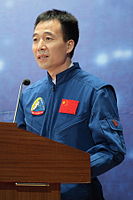 Jing Haipeng(景海鹏)
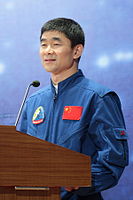 Liu Boming (刘伯明)
 Liu Wang (刘旺)
 Liu Yang (刘洋)
 Nie Haisheng (聂海胜)
 Yang Liwei (杨利伟)
 Zhai Zhigang (翟志刚)





.jpg)
.jpg)
_cropped.jpg)
.jpg)


.jpg)

.jpg)


.jpg)

.jpg)
.jpg)

.jpg)